Hi…
We’ll explore what the CAP Theorem is, why it matters, and how it influences real-world system design. lets go on..
What Is the CAP Theorem?
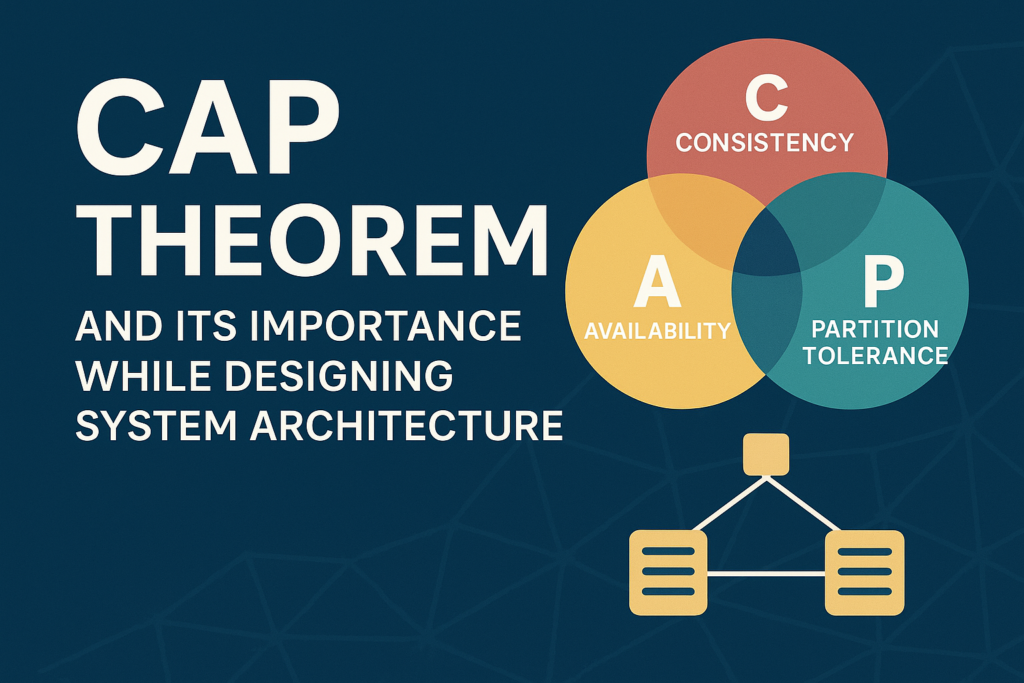
The CAP Theorem, proposed by computer scientist Eric Brewer, states that a distributed system can guarantee only two out of the following three properties at the same time:
- Consistency (C)
Every read receives the most recent write or an error. All nodes see the same data at the same time. - Availability (A)
Every request receives a response, even if that response does not contain the latest data. - Partition Tolerance (P)
The system continues to operate despite network failures or communication breakdowns between nodes.
In short: You can’t have Consistency, Availability, and Partition Tolerance all at once.
CAP Trade-offs Explained
1. CP (Consistency + Partition Tolerance)
These systems prioritize data correctness over uptime.
- If a network partition occurs, the system may reject requests to avoid returning stale data.
- Ideal for systems where accuracy is critical.
Examples:
- Banking systems
- Distributed databases like HBase or MongoDB (in strong consistency modes)
Use when:
Incorrect data is worse than temporary downtime.
2. AP (Availability + Partition Tolerance)
These systems prioritize uptime over immediate consistency.
- The system continues to respond during network partitions.
- Data may be eventually consistent.
Examples:
- DNS
- Cassandra, DynamoDB
- Social media feeds, product catalogs
Use when:
High availability is more important than having the latest data instantly.
3. CA (Consistency + Availability)
This combination works only in non-distributed or single-node systems.
- No network partitions assumed.
- Not realistic for large-scale distributed architectures.

Hold.. Lot of content right… lets go with example….
For example, banking systems usually focus more on consistency so that data is always correct, even if the system becomes temporarily unavailable. On the other hand, systems like social media platforms may choose availability, allowing users to continue accessing the system even if some data is slightly outdated.
By using the CAP Theorem, system architects can clearly understand trade-offs and select the right approach based on the system’s purpose. This leads to more reliable, scalable, and practical system designs. here a few more detail….
1. Guides Technology Selection
Understanding CAP helps architects choose the right databases, messaging systems, and storage solutions based on business needs rather than hype.
Example:
- Financial ledger → CP database
- Recommendation engine → AP database
2. Aligns Architecture With Business Priorities
CAP trade-offs force clarity around questions like:
- Is downtime acceptable?
- Can users tolerate stale data?
- What are the consequences of inconsistency?
Architecture decisions become business-driven, not just technical.
3. Sets Realistic Expectations
CAP Theorem helps stakeholders understand that:
- Perfect systems don’t exist
- Trade-offs are intentional, not flaws
- “100% uptime + perfect consistency” is unrealistic at scale
4. Influences Microservices and Cloud Design
In microservices architectures:
- Services often favor availability
- Event-driven systems embrace eventual consistency
- Architects design compensating transactions and retries
CAP thinking directly impacts:
- API design
- Data replication strategies
- Failover and recovery mechanisms
CAP Theorem vs. Real-World Systems
It’s important to note that CAP is not a strict on/off switch. Modern systems often allow you to tune consistency levels depending on the use case.
For example:
- Read-after-write consistency for critical paths
- Eventual consistency for analytics or background processing
This flexibility enables hybrid architectures that balance user experience and correctness.
Conclusion
The CAP Theorem is a cornerstone concept for anyone designing distributed systems. It doesn’t limit innovation instead, it empowers architects to make conscious, informed trade-offs.
By understanding CAP:
- You design systems that fail gracefully
- You align technology with business goals
- You avoid unrealistic expectations
In distributed architecture, trade-offs are inevitable but poor decisions are not.
Keep coding….