Over the weekend, I read Magic Words by Jonah Berger.
It’s one of those books where you read a chapter(Leverage Concreteness) and start noticing the same ideas in your everyday conversations.
A few ideas from the book particularly caught my attention:
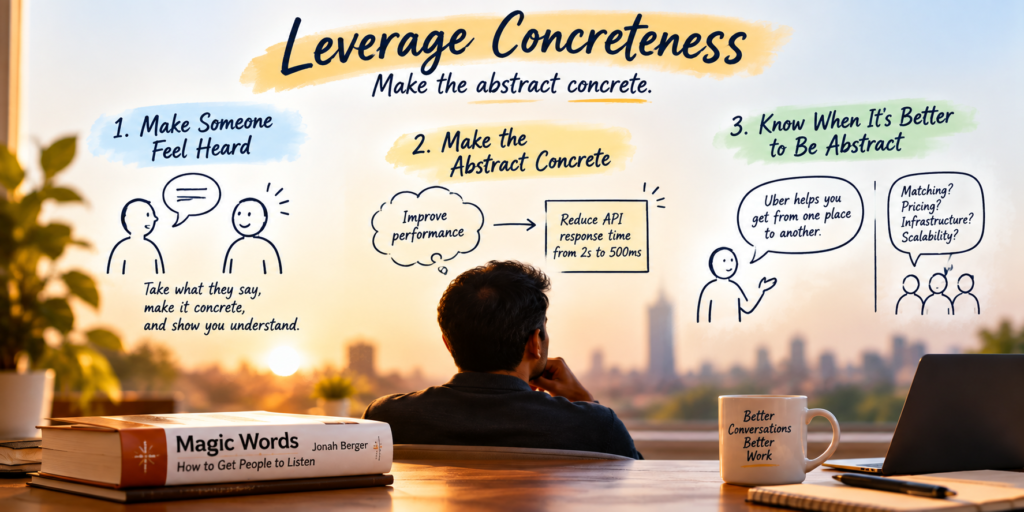
1. How to make someone feel heard
Sometimes it’s not about giving an answer.
It’s about showing the other person that you actually understood what they were trying to say.
Instead of responding to:
“I’m struggling with this process.”
with:
“Okay, let’s fix the process.”
Sometimes it’s better to clarify:
“You mean the process is taking too much time because you’re repeating the same steps?”
Making the abstract concrete can make someone feel that you’ve actually heard them.
2. Make the abstract concrete
We often use abstract words without realizing it.
Words like:
“Improve performance.”
“Make it scalable.”
“We need better communication.”
But what does better actually mean?
The moment we make it concrete, the conversation becomes much easier.
“Reduce the API response time from 2 seconds to 500ms.”
Now we’re talking about something measurable.
3. Know when it’s better to be abstract
But concrete isn’t always better.
If I’m explaining Uber to someone who simply wants to understand the product, I don’t need to explain its matching algorithms, distributed systems, pricing engine, or infrastructure.
I can simply say:
“Uber helps you get from one place to another.”
That’s enough.
But if I’m talking to an engineer, I might need to go much deeper.
So the real skill isn’t always being concrete.
It’s knowing when to be concrete and when to stay abstract.
My takeaway
All three ideas made me think about the same thing:
Good communication is about meeting the other person at the right level.
Sometimes they need the big picture.
Sometimes they need the details.
And sometimes they simply need to know that you’ve understood them.
As we move into leadership, I think this becomes even more important.
Don’t just ask, “What should I say?”
Ask:
“What does this person need from me right now?”
That’s probably my biggest takeaway from this weekend’s reading.
I’ve also put together a short summary of the book here: