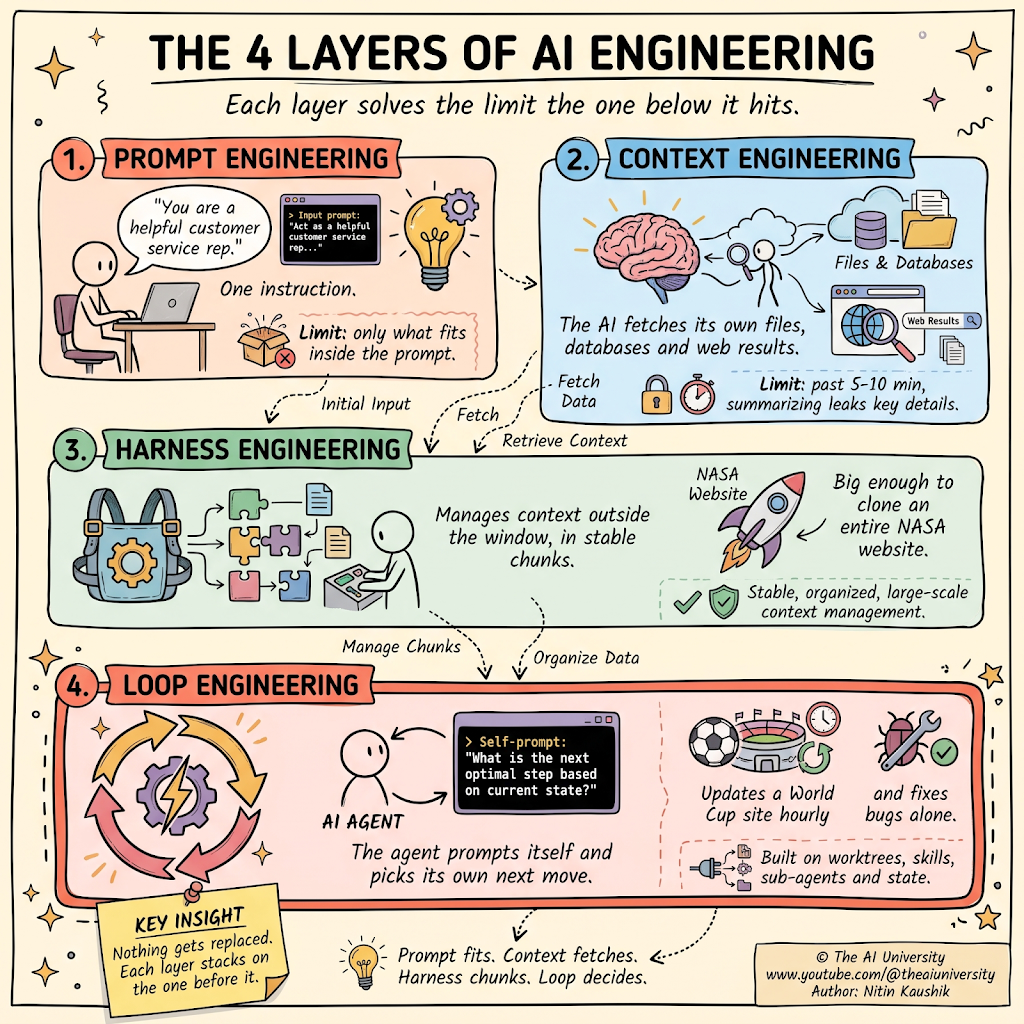
Building AI applications is no longer just about writing a good prompt.
As AI systems become more agentic, four engineering concepts are becoming increasingly important:
Prompt Engineering → Context Engineering → Harness Engineering → Loop Engineering
Think of them as four layers of a production AI agent.
| Layer | Key Question | What it does | Example |
|---|---|---|---|
| Prompt Engineering | What should AI do? | Defines instructions, role, rules and output | “Analyze this stock and give Buy/Hold/Sell.” |
| Context Engineering | What does AI need to know? | Provides relevant data and state | Price, news, fundamentals, portfolio, history |
| Harness Engineering | What can AI do? | Provides tools, APIs, permissions and guardrails | Market API, database, Python, Telegram |
| Loop Engineering | How does AI continue? | Enables execution, verification, retry and escalation | Observe → Act → Verify → Retry |
A simple example
Imagine an AI incident-response agent.
1. Prompt Engineering
Tell the agent what its job is:
“Investigate production incidents, identify the likely root cause, and provide evidence. Don’t make production changes without approval.”
2. Context Engineering
Give it the information it needs:
Error rate: 15%
Recent deployment: v3.4.2
Service: Payment API
Recent logs: ...
Recent code changes: ...
3. Harness Engineering
Give the agent controlled access to:
Grafana
CloudWatch
Kubernetes
GitHub
Jira
Slack
With permissions such as:
Read logs       → Allowed
Read metrics    → Allowed
Create Jira     → Allowed
Restart service → Requires approval
Production deploy → Not allowed
4. Loop Engineering
Now the agent can operate:
Observe
  ↓
Analyze
  ↓
Take action
  ↓
Verify
  ↓
Retry / Escalate
  ↓
Complete
This is the key difference between a simple LLM application and an AI agent.
The mental model
Prompt
"What should I do?"
        ↓
Context
"What do I need to know?"
        ↓
Harness
"What can I access and do?"
        ↓
Loop
"How do I execute and verify?"
The takeaway
Prompt Engineering gives AI instructions.
Context Engineering gives it the right information.
Harness Engineering gives it tools and guardrails.
Loop Engineering makes it execute, verify and recover.
The real challenge in modern AI engineering is no longer just getting a good answer.
It is building a system that can reason, act, verify and safely repeat.
Ref.. Links: