AI coding tools have evolved rapidly.
A couple of years ago, they were great at generating code snippets. Today, they’re becoming AI agents that can understand projects, reason about problems, and complete engineering tasks.
One project that caught my attention is Goose AI. Since it’s open source, I wanted to understand what makes it different from tools like Claude Code, GitHub Copilot, and Cursor.
Here’s what I found
What is Goose AI?
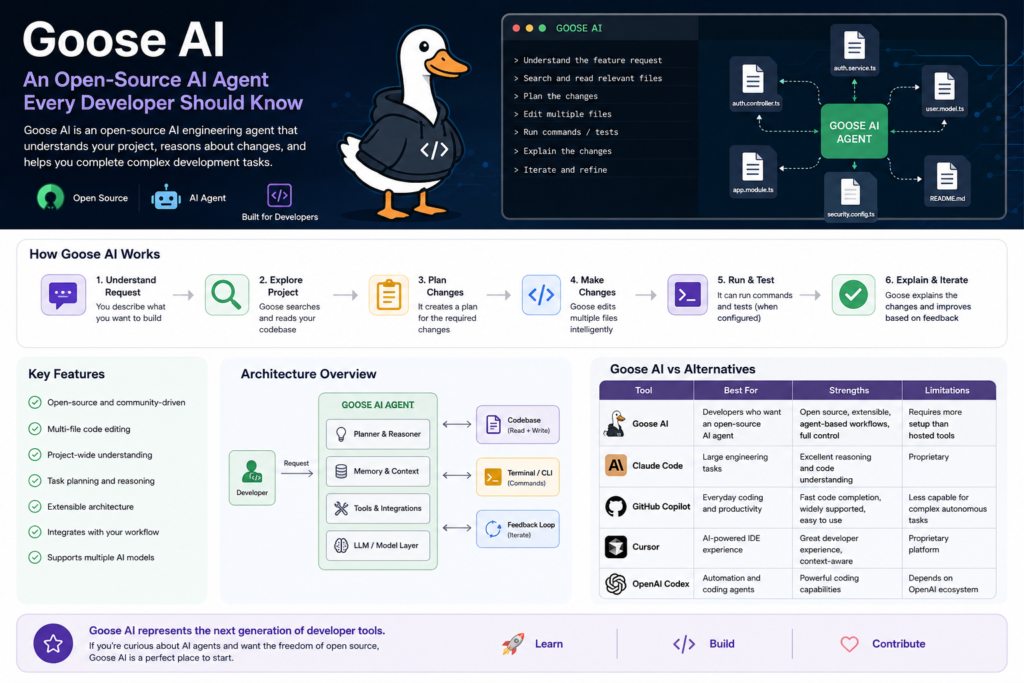
Goose AI is an open-source AI engineering agent.
Instead of just suggesting the next line of code, it understands your codebase, plans a solution, edits multiple files, and explains the changes.
Think of it as an AI teammate that helps complete engineering tasks rather than simply generating code.
For example, if you ask:
“Add JWT authentication to my Spring Boot application.”
Goose can analyze the existing project, update multiple files, generate the required classes, and suggest how to validate the implementation.
That’s the difference between a coding assistant and an AI agent.
What Makes Goose AI Interesting?
The biggest strength of Goose AI is its agentic workflow.
Instead of responding to a single prompt, it can plan a sequence of actions to achieve a goal.
Some highlights include:
- Open source and extensible
- Project-wide code understanding
- Multi-file editing
- Task planning and reasoning
- Support for multiple AI models
Being open source also means you can inspect, customize, and extend it to fit your own workflow.
Goose AI vs Other AI Tools
| Tool | Best Use Case |
|---|---|
| Goose AI | Multi-step engineering tasks and customizable AI workflows |
| Claude Code | Large codebases, architecture, and complex reasoning |
| GitHub Copilot | Fast code completion inside your IDE |
| Cursor | AI-first development experience |
| OpenAI Codex | Coding automation and AI-powered development |
Each tool has its strengths. Goose AI stands out if you want an open-source AI agent rather than just an AI coding assistant.
When Should You Use Goose AI?
Goose AI is a good choice when you need to:
- Implement features across multiple files
- Understand an unfamiliar codebase
- Refactor large projects
- Experiment with AI agents
- Build customized AI engineering workflows
For quick code suggestions, Copilot or Cursor are often the simpler choice.
Final Thoughts
What I like about Goose AI isn’t just that it’s open source—it’s the direction it represents.
We’re moving beyond AI that simply writes code toward AI that can understand goals and help complete engineering tasks.
Whether Goose AI becomes part of your daily workflow or not, it’s worth exploring because it offers a practical look at where AI-assisted software development is heading.
ref: link – https://goose.ai/