Last week, one of my previous org. engineer pinged me on whatsapp.
“Which AI coding tool should the team standardize on — Copilot or Cursor or Claude ?”
I typed out a tool name. Deleted it. Typed another one. Deleted that too.
Then I just called him instead, because I realized I didn’t actually have an honest one-line answer.
The tool isn’t the decision. The harness is.
The Context
I run all three, more or less every day. Claude Code at work through AWS Bedrock, a personal Claude Pro subscription for my learning projects, and GitHub Copilot on my company laptop….
All three are genuinely good. That’s exactly what makes the question annoying.
Claude, GPT, Grok, Gemini – the models rotate in and out of all three tools depending on who shipped a better checkpoint last month. So “which model is smarter” is a debate with a shelf life of about six weeks.
If the model underneath is basically a coin flip, why does switching tools feel like switching jobs?
Because you’re not switching models. You’re switching harnesses – and nobody tells you that part.
What I’ve Observed
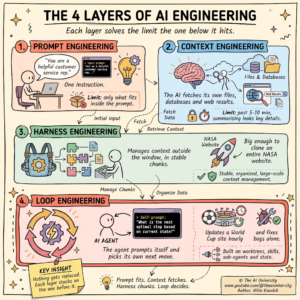
A harness is the scaffolding wrapped around the model. It decides how the thing reads your files, how much it’s allowed to do before it taps you on the shoulder, and where it physically sits while it works.
Same underlying intelligence, three very different Monday mornings:
- With Copilot, I stay exactly where I am. Open file, cursor blinking, can use multi models ….
- With Cursor, my editor stops being an editor and starts acting like a junior dev with opinions.
- With Claude Code, I write a brief in the terminal or vs code extestion with strict aunthropic models
I learned this the hard way, not from a comparison chart. I once dumped a genuinely large refactor into Copilot’s agent mode expecting Claude-Code-style patience. It did its best. It also lost the thread by file six and started “fixing” things I hadn’t asked it to touch. Not a bad tool – just the wrong harness for that particular job.
Inside a Harness — High-Level Architecture
Strip away the branding and every harness is the same four-step pipeline.
You (the ask)
     │
     ▼
Context Loader   →  repo files, CLAUDE.md / rules, history
     │
     ▼
Model (LLM)      →  Claude / GPT / Grok — the swappable part
     │
     ▼
Tool Executor    →  edit files, run tests, search, git
     │
     ▼
Guardrails       →  approvals, CI, branch rules
     │
     ▼
Diff / PR — back to you
Only one of those four boxes is the model. The other three are the harness – and that’s where the real engineering lives.
The model gets swapped out on someone else’s schedule. The harness is the part you actually design, and it’s what decides whether the output is safe to merge.
The Mental Model
I stopped asking “which tool is best” and started asking my team three questions instead.
1. Where do you want the work to happen? Inside your editor, or somewhere you don’t have to watch?
2. How much do you want to supervise? Line-by-line, approving each suggestion – or a task you hand off and check on at lunch?
3. How big is the actual job? A function, a file, or something that touches half the repo?
- Small, in-flow edit → IDE-embedded.
- Multi-file change, but you’re staying in the editor → editor-native agent.
- Hand it off and walk away → terminal-autonomous.
Answer those three honestly and the tool name stops mattering. It just falls out of the answer.
The Real Insight
Four things are moving right now, all at once:
- Models are improving faster than anyone can track — January’s “best” is September’s middle-of-the-pack
- Pricing keeps getting rewritten — subscriptions, credits, usage-based billing, bundled agent access
- Free and open models are closing the gap — yesterday’s paid-only capability is next year’s free tier
- Organizations are starting to train their own — for some teams, “which public model” won’t even be the question much longer
Four moving parts, one conclusion: the model is the least stable layer in this stack. Not something worth building your workflow around.
Bet on the layer that outlives the model swap. That’s the harness.
The harness is the part you actually get to design. The model is someone else’s decision, on their release schedule.
Common Mistakes
The mistake I see most on my own team isn’t picking the “wrong” tool. It’s picking for the wrong reason.
- Jumping to whichever model just topped a leaderboard, then jumping again next week
- Using a tool because you already have access to it, not because it fits the job
- Optimizing for the fastest first response instead of the diff you’d actually merge
- Handing a two-line fix to a terminal-autonomous agent — overkill, and it’ll find something else to “improve” while it’s in there
- Handing a repo-wide refactor to an IDE-embedded agent — it wanders by file six, ask me how I know
“I have access to it” and “it fits this job” are two different sentences. Don’t let the first one answer for the second.
My Take
AI is still built by humans, trained on human mistakes, and it makes plenty of its own. That’s not a phase we’re waiting out – that’s the baseline every one of these tools ships with, today and probably for a while.
No harness makes that go away. What a good harness gives you is somewhere to put your own protection around it – your tests, your CI gates, your code review, your CLAUDE.md rules, your branch protections. Build that custom environment once, around your standards, and it protects your code quality no matter which model gets swapped in underneath next quarter.
Stop asking which AI coding tool is “the best.” Ask where you want the work to happen, how much supervision you’re willing to give up, and what guardrails you’re putting around it either way.
The harness’s whole job is to help you do your job. Not replace your judgment on what’s safe to ship.
Next time someone on my team asks me the Copilot-vs-Cursor-vs-something else question, I’m sending them this post instead of a whatsapp message I’ll regret in three weeks.
References
- Claude pricing: https://www.claude.com/pricing
- GitHub Copilot plans: https://github.com/features/copilot/plans
- Cursor pricing: https://cursor.com/pricing
- Claude Code documentation: https://docs.claude.com/en/docs/claude-code
Keep coding.…